
To download the Auspice June Blog as a PDF, click here.
This commentary is intended for general informational purposes only and does not constitute investment advice or a recommendation.
This month's blog will highlight the Auspice Commodity Investor's Guide (CIG) we published June 10th, alongside some recent related data points we have observed regarding commodities.
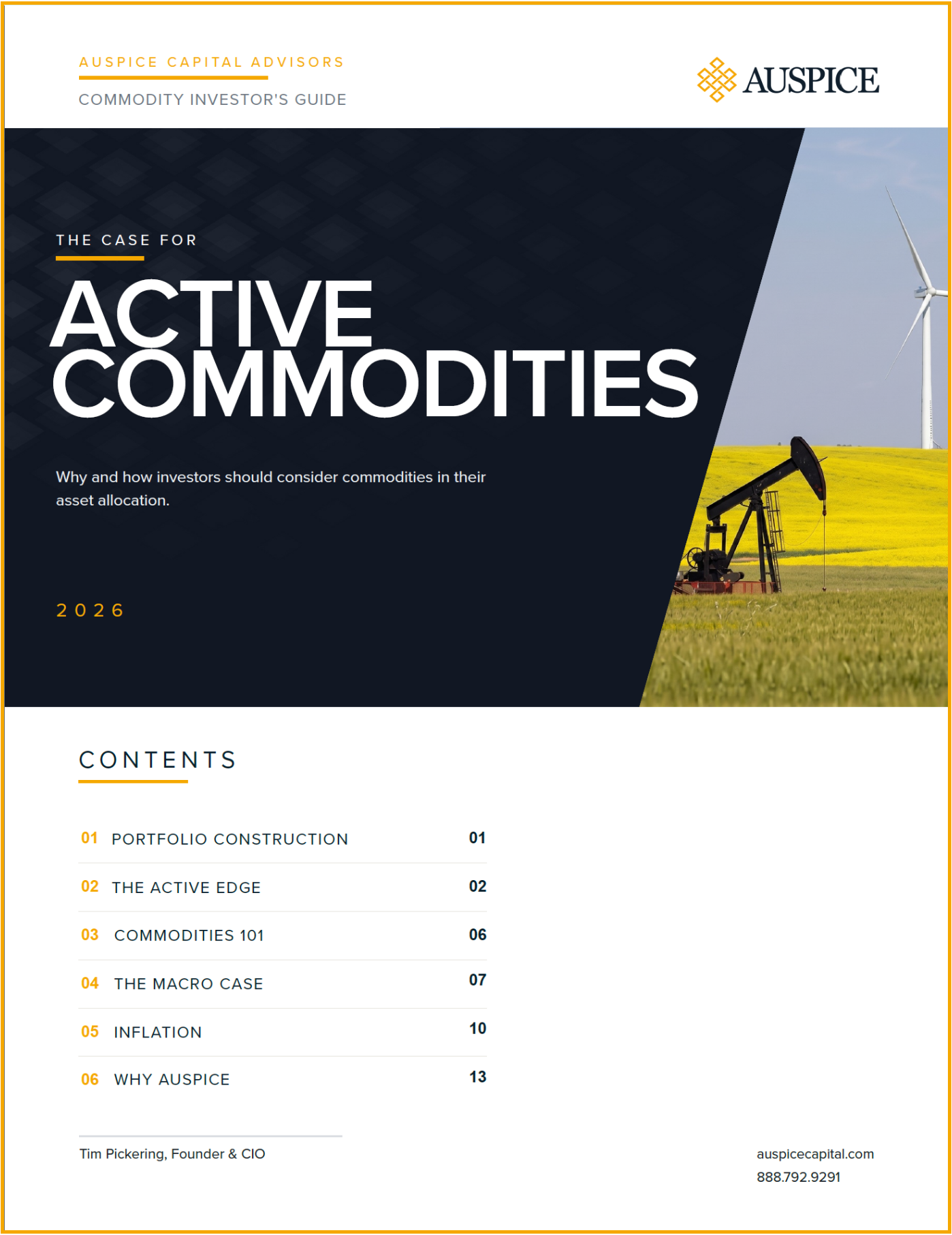
The CIG was created to address two of the main topics of conversation we find ourselves having with anyone looking at the commodity space - the structural case for the sector and the empirical case for active commodity exposure management. The foundation is simple. We believe commodities are a third source of return, independent of equities and fixed income, that have historically improved portfolio diversification, drawdowns, and risk-adjusted returns.
Our guide lifts the hood on the differences in how investors choose to gain access to their exposure, highlighting that passive commodity approaches or Gold alone often disappoint over time and where the active edge exists. It also explains how physical commodities not only differ from stocks and bonds, but also where resource equities fall short as a proxy, and what that shortfall means with respect to portfolio diversification across business cycles. Underlying all of this is the real connection between commodities and inflation: they are a source of it, not a reaction to it.
Lastly, we explore the difference between a commodity cycle and a supercycle, why we could be in the latter, and a new emerging demand shock, alongside what institutional investors are doing to position for it. Best part? You can too!
Gold:
We have said for many years that Gold is the most complex of commodities. Is it a commodity? A currency? A store of value? Likely all three. But what it is not is a great inflation hedge. There is no statistical evidence of that.
The CIG deals with this common misnomer in the financial community, both retail and institutional alike. Quite simply, Gold continues to disappoint if its intended purpose is to hedge inflation. It did not show up in 2020-2022 as CPI went to 9.1% from nothing. "During the early-2021 to mid-2022 inflation surge, US YoY CPI peaked at 9.1%. Virtually every conventional hedge disappointed. Gold lost 9.2% in absolute terms, with a real return of roughly -21%”. Again, here in 2026, as the Iran/Israel/US war hit and the Strait of Hormuz exacerbated commodity prices, Gold did not show up. It has been in steady decline since the beginning of the year, down 9%, and is off over 25% since peaking on Jan 29th.
The evidence and subsequent conclusion suggests Gold has an inconsistent relationship with inflation over shorter time horizons. It is a statistical diversifier but not a reliable inflation hedge. While Gold has experienced significant rallies in recent years, they came as we dis-inflated from 9.1% towards the 3% 100-year average, not as inflation rose. The irony is that gold is often bought as a diversifier and an inflation hedge, yet a concentrated, single-asset position delivers neither reliably: it adds idiosyncratic risk, and its link to inflation is inconsistent at best.
Our conclusion in the guide is that broad commodity exposure avoids that concentration and has historically shown consistent positive beta to inflation across multiple sectors.
Current Risk:
While broad exposure is optimal, there is a distinct risk in how many investors actually access the asset class: commodity beta indices such as the Bloomberg Commodity Index (BCOM) or related products like ETFs that are simply replicas with high correlation. Despite looking diversified on the surface, the risk is concentration.
How risky are the long-only commodity beta indices and related ETFs? Per the recent Apollo paper, aptly titled “Commodity prices are moving higher” (p6/7) the S&P GSCI has a 61% energy weight1. BCOM has a 29% weight. That is a significant concentration. These indices are "production" weighted and rebalanced annually. This ignores price and event risk.
Per our recently published interview in the Globe and Mail, "… passive exposure through commodity indexes can be risky, as some indexes react brilliantly to an event like Iran and the Strait of Hormuz, but then drop violently.” He says ”… the commodity sleeve in a portfolio requires active management."
Yet what about other commodities? Non-energy prices remain elevated, now above the 2011 highs while below 2008 highs.
A Reminder:
Oil does not define all commodities, nor does Gold, or any other single market or even commodity sub-sector. As such, recent gains in commodity beta products and related ETFs should be viewed with caution.
The opportunity we see in commodities is broad, and commodity prices are moving higher across the board, but for different reasons in each segment. For example, the Middle East impacts energy and fertilizer. Data center buildout impacts base metals. Market risk and reality of inflation drives safe-haven demand for precious metals.
We believe the most responsible way to gain exposure is broadly across commodities, diversified by risk , not production weighting or holding a highly correlated/high-beta investment product that does not incorporate active risk management or a systematic trend-following investment process.
Using an active, rules-based approach addresses that structural weakness directly. Rather than holding full exposure regardless of market conditions, a systematic trend-following strategy can reduce risk or exit when commodity trends turn negative – reducing drawdown risk without requiring investors and advisors to time the market. The difference is not about forecasting; it is about having a mechanism to step aside.
For example, as the price and volatility of crude exploded higher at the end of February, Auspice took profits and reduced the risk for the next couple of months, such that when the price started falling in May (and continued in June), we limited the downside. Prior to this, we did the same with Silver in late 2025 and early 2026.
We call it commodities with airbags.
SOURCES
https://www.apollo.com/content/dam/apolloaem/pdf/daily-spark/2026/jun/15/061526-Commodity%20prices_v2.pdf?utm_medium=email&utm_source=pardot&utm_id=7136d200df7e09473afe6be1b9ef53bd&utm_campaign=EXT_Daily+Spark&utm_content=body-textlink-dailyspark-here
IMPORTANT DISCLAIMERS AND NOTES
There is a substantial risk of loss in trading futures and options. Past performance is not necessarily indicative of future results. The views expressed are those of the author and do not constitute investment advice.
Commissions, trailing commissions, management fees and expenses may all be associated with investment funds. Please read the prospectus or applicable offering document before investing. Investment funds are not guaranteed, their values change frequently and past performance may not be repeated.
All data is believed to be reliable but has not been independently verified.
The indices shown (Charts 1-5) are for illustrative purposes only. Index returns do not reflect the deduction of fees, expenses or transaction costs. Past performance is not indicative of future results. The referenced indices are not directly investable. Also, where ETF or index proxies are used, they are intended to approximate the performance of the underlying strategy and may not reflect actual investable results.
These materials are provided for informational and educational purposes and are not intended to provide specific individual advice including, without limitation, investment, financial, legal, accounting and tax. Please consult with your own professional advisor on your particular circumstances.
Futures trading is speculative and is not suitable for all customers. Past results are not necessarily indicative of future results. This document is for information purposes only and should not be construed as an offer, recommendation or solicitation to conclude a transaction and should not be treated as giving investment advice. Auspice Capital Advisors Ltd. (the “Manager” or “Auspice”) makes no representation or warranty relating to any information herein, which is derived from independent sources. No securities regulatory authority has expressed an opinion about the securities offered herein and it is an offence to claim otherwise. Please read the applicable offering documents before investing.
This material may contain forward-looking statements, which were prepared for the purpose of providing general educational background information and may not be appropriate for other purposes. Certain statements in this document are forward- looking statements, including those identified by the expressions “anticipate”, “believe”, “plan”, “estimate”, “expect”, “intend”, “target”, “seek”, “will” and similar expressions to the extent they relate to an Auspice managed investment fund (the “Fund”), where applicable, and the Manager. Forward- looking statements are not purely historical facts but reflect the current expectations of the Fund, where applicable, and the Manager regarding future results or events. Such forward-looking statements reflect the Fund’s, where applicable, and the Manager’s current, reasonable beliefs and are based on information currently available to them. Forward-looking statements are made with assumptions and involve significant risks and uncertainties. Although the forward-looking statements contained in this document are based upon assumptions that the Fund, where applicable, and the Manager believe to be reasonable, neither the Fund, where applicable, or the Manager can assure investors that actual results will be consistent with these forward-looking statements. There is no guarantee that any forward-looking statement will come to pass. As a result, readers are cautioned not to place undue reliance on these statements as a number of factors could cause actual results or events to differ materially from current expectations.
Neither the Fund, where applicable, nor the Manager assumes any obligation to update or revise any forward-looking statement to reflect new events or circumstances, except as required by law.
The Manager may present the enclosed information in a blog – such blog may contain hypertext links to web sites owned and controlled by parties other than Auspice. We have no control over any third-party-owned web sites or content referred to, accessed by or available on such web site and therefore we do not endorse, sponsor, recommend or otherwise accept any responsibility for such third-party web sites or content or for the availability of such web sites. In particular, we do not accept any liability arising out of any allegation that any third-party-owned content (whether published on this or any other web site) infringes the intellectual property rights of any person, or any liability arising out of any information or opinion contained on such third-party web site or content.